
Homeowners · Prepare
Know your risk before you decide what to prepare for

Written by Andy Kruger
BuildSOS CEO
You can’t prepare for everything equally, and you don’t need to. Your home’s real exposure to flood, wildfire, wind, and heat is specific to where you live, down to the address, not just the region. Knowing your numbers turns “I should probably get ready for hurricane season” into a short, specific list of the things that actually matter for your home.
Why “regional” risk isn’t specific enough
Two homes ten miles apart can carry completely different risk profiles. Elevation, distance from a floodplain, vegetation density, and even which side of a ridge a house sits on all change the picture. National and even state-level disaster statistics tell you what’s common in your area. They don’t tell you what’s true for your address.
That gap is why a personal risk score matters more than a general awareness that “hurricanes happen here” or “wildfires happen here.” FEMA’s National Risk Index and similar tools now make address-level data available for free, and BuildSOS builds on that same kind of data to give you a Flood, Fire, Wind, Air, and Heat score specific to your home.
How to use your risk score once you have it
A risk score isn’t just a number to note and forget. Use it to sequence your preparation:
- Start with your highest score. If Fire is your highest number, start with Wildfire risk & defense, not a general emergency kit.
- Cross-reference with your insurance. A high Flood score is your cue to check whether you actually have flood coverage, since it’s excluded from standard policies almost everywhere.
- Revisit annually. Risk maps get updated as flood zones, wildfire perimeters, and climate patterns shift. A score from three years ago may not reflect your current exposure.
- Share it with your household. Everyone under your roof making decisions during an actual emergency benefits from knowing which hazard is the real concern, not a vague sense of “something could happen.”
Want your personalized preparedness score?
The Resilience Game turns this guide into a step-by-step plan for your household.
Frequently asked
Is a low risk score a guarantee nothing will happen?
No hazard score is ever zero. A low score means that hazard isn’t your top priority relative to others, not that it’s impossible. Basic preparedness still matters everywhere.
How is a personal risk score different from what my insurance company uses?
Insurers often use proprietary, more granular models that factor in construction details and claims history specific to your policy. Your BuildSOS risk score is a strong starting point for your own planning, but it isn’t the same calculation your insurer runs when setting your premium.
Can my risk score change without my home changing?
Yes. Updated flood maps, new wildfire perimeter data, or revised climate modeling can shift your score even if nothing about your house has changed. This is part of why an annual check makes sense.
What's in this guide
Your personal risk score
Get your Flood, Fire, Wind, Air, and Heat scores for your exact address, free.
Hurricane risk & season guide
What to know before June 1st if you’re in a hurricane-prone area, including wind mitigation, storm surge, and evacuation zones.
Wildfire risk & defense
Defensible space, ignition-resistant materials, and what actually protects a home in fire country.
Flood risk & prevention
Understanding your flood zone, base flood elevation, and what your policy does and doesn’t cover.
Tornado & severe storm readiness
Safe rooms, sheltering, and what to secure before a storm.
Winter storm & extreme cold readiness
Ice dams, frozen pipes, and staying safe through winter weather.
Free app · iOS & Android
Can you survive the first 72 hours?
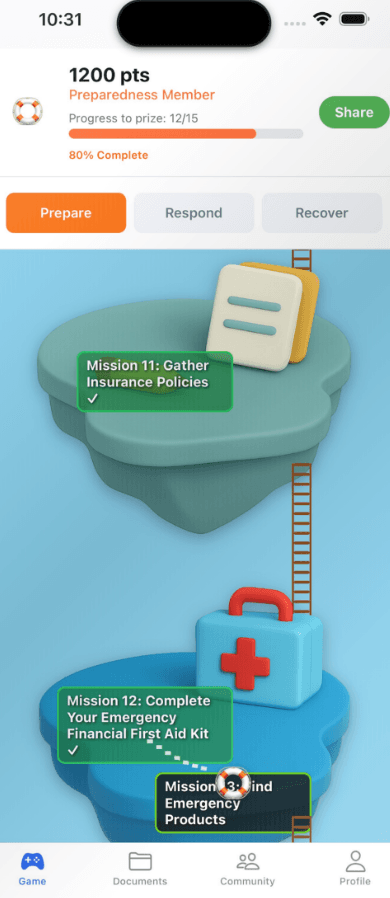
Most people think they can. The Resilience Game walks you through the preparedness journey, mission by mission, and shows you exactly where the gaps are, before you find out the hard way.
About the author
Andy Kruger
Andy Kruger is CEO of BuildSOS, author of When the Storm Comes, and sits on multiple boards and advisory groups shaping disaster resilience policy and research.
About Andy